
Specifying a safety edge starts from the point where something closes, not from a profile code. A pressure-sensitive safety edge detects contact when its elastic profile is compressed. The resulting signal is handled by a control unit within the machine’s safety function, together with the stopping system. This guide sets out what to gather before an enquiry, so that the technical review can start from your machine. Profiles, series and documents are on the safety edges page.
In this article
Start from the closing point
Describe where a moving part can meet a person or an obstacle:
- which part moves, in which direction, and what it closes against;
- the side and the length of the edge that has to detect contact;
- where people stand or reach in while the part is moving.
Typical closing points are the edge of a guard or sliding door, the lower edge of a powered shutter or cover, laser enclosures and CNC machines. On shuttles for internal transport the edge travels with the vehicle, so footprint, routes and stopping conditions are part of the picture: see safety bumpers and edges on an AGV.
Profile: what it has to fit
The rubber profile deforms elastically. It is not chosen by size alone: its shape and the travel available are weighed against the mounting space, the movement and the function to be achieved. Available space and the travel required must be assessed together; the outer dimensions of a profile alone do not define the configuration.
The Standard series offers several geometries: BOS-2220, BOS-2231, BOS-3143 and BOS-4060. The values for each profile are in the Standard series datasheet. If you are unsure, describe the space and the movement and leave the choice of profile to the technical review.
Mounting is part of the design
Profile, support and position work together. Useful details:
- the surface the edge will be fixed to, and the space around it;
- any constraints on the position of the fixing holes;
- the overall length of the edge.
In the configurator, the mounting guide for the profile is one of the choices. If the edge has to follow a corner or a special shape, describe it with a sketch: arrangements outside the standard configurations are assessed case by case in the application review.
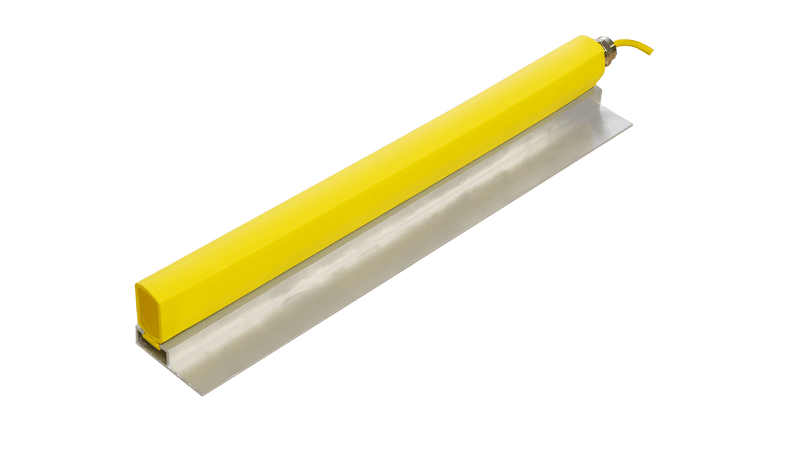
Wiring and the control unit
Note where the cable can leave the edge, the length it needs to reach the cabinet and the connector you expect.
There are two series to consider. The COE series uses a co-extruded profile with built-in conductors and a terminal resistor. It connects with two poles, and several edges in series work on a single module. Combinations with control units, connections and limits are checked in the COE series datasheet, in the Standard series datasheet and in Operating principle and connection.
You do not need to work out compatibility yourself. Tell us which control unit or safety inputs are already on the machine; the safety control units page shows the range. For an explanation of the term OSSD, see What is an OSSD output.
Checklist for your enquiry
- The moving part, its direction and what it closes against.
- The side and length of the edge that has to detect contact.
- The space available for profile and support.
- The mounting surface and any constraints on fixing holes.
- Cable exit, route and length to the cabinet, and the connector.
- The control unit or safety inputs already on the machine.
- The movement that has to be stopped, and how stopping is handled today.
A description in words is fine where a measurement is not yet available.
From configurator to enquiry
For Standard series configurations, the safety edges configurator takes you through profile, guide, cable and request. For a special shape or mounting, or if you are not sure which profile to start from, describe the application in Tell us about your application.
Risk assessment, installation and validation of the complete safety function stay with the machine builder or the person responsible for safety. Our part is to assess whether the edge and its configuration suit the application.