
A pressure-sensitive safety mat built around a machine starts from the area it has to protect, not from a catalogue size. The more clearly that area is described, the sooner the technical discussion can move from “is it feasible?” to “how should it be configured?”. This guide lists the information worth gathering before you get in touch: the layout, how the area is really used, cables and installation, zones and the electronics already on the machine.
In this article
Start from the layout
Start by describing the area and add a dimensioned sketch if you have one. Useful details include:
- the footprint of the area to protect and its overall dimensions;
- cut-outs and fixed obstacles inside it, such as machine feet, columns or guards;
- the space actually available for installation, and the type of floor the mat will lie on;
- where the operator stands and how they move through the area.
When you receive a proposal, ask the technical department to identify the overall mat dimensions and the pressure-sensitive area on your layout.
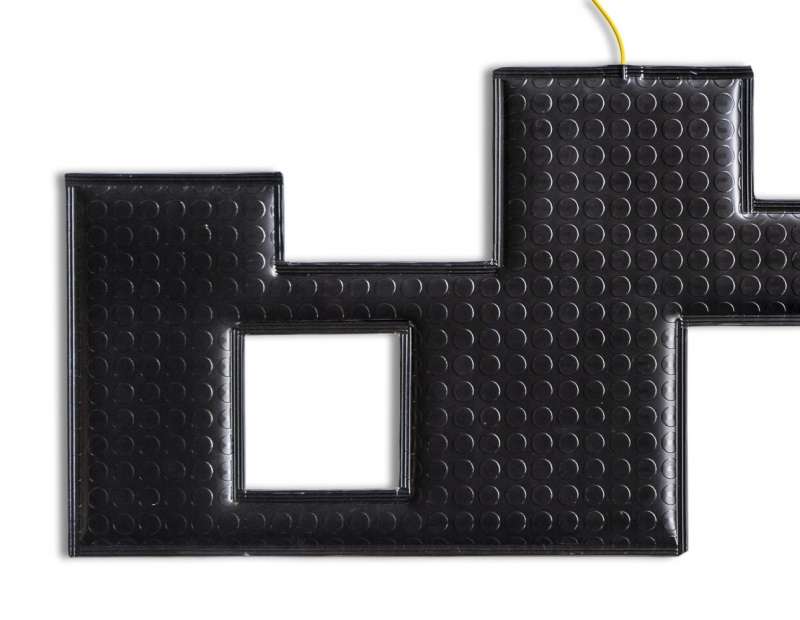
Describe how the area is really used
The same footprint can mean very different things on two machines. Describe who steps on the area, how often, and what else crosses it: trolleys, pallets or other traffic, if any. Mention liquids, dust, cleaning routines or other site conditions.
None of these details makes a mat suitable or unsuitable on its own. They are what the technical department needs to assess the configuration for your application.
Cables, edges and installation
Cables and connections are defined on the integration, so it helps to know early:
- where the cable can leave the mat and which route it can follow to the cabinet;
- whether the edges of the mat will be walked over, and from which sides;
- whether several mats will be laid side by side to cover the area.
Laying mats side by side is a design choice in its own right. Whether the result can be treated as a single protected surface is not a general rule: it depends on the arrangement, on the gaps between the sensitive surfaces and on the installation.
One zone or several
If the machine has to react differently depending on where a person stands, say so in the enquiry and describe the areas in words. A multi-zone mat divides the surface into separate areas, each with its own signal. To distinguish the zones, each zone has its own control unit and a separate connection to the electronics. A control unit cannot distinguish zones wired to the same input. The number of units, wiring and cabinet space are defined in the design.
Keep safety and command separate in your description. A zone that contributes to stopping the machine and a zone used as a foot command are different functions, with different electronics. A safety mat is not a switch for turning the machine on and off: the product manual forbids that use. The multi-zone safety mats page explains the principle in more detail.
The electronics already on the machine
The mat is one part of a safety function that also includes the control unit, the connections and the machine stop. Before the enquiry, note what is already installed: safety control units, safety inputs on the machine logic, and how the stop is handled today.
You do not need to work out compatibility yourself. If the terms are unclear, the guide What is an OSSD output explains the difference between the signal of a pressure-sensitive device and the output of its control unit.
Checklist for your enquiry
- Area layout, with cut-outs, fixed obstacles and any available dimensions.
- Where the operator stands and how they move.
- What else crosses the area, and the site conditions: liquids, dust, cleaning.
- Floor type and the space available for installation.
- Possible cable exit and route to the cabinet.
- One zone or several, and what each should do: safety, command, or still to be assessed.
- Safety electronics already on the machine.
- The movements that have to be stopped.
A description in words is fine where a measurement is not yet available.
Tell us about your application
Risk assessment, installation and validation of the complete safety function stay with the machine builder or the person responsible for safety. Our part is to assess whether the device suits the application. The safety mats page shows shapes, operating principle and documentation.